Automated Crypto Portfolio Rebalancing Bot Strategy
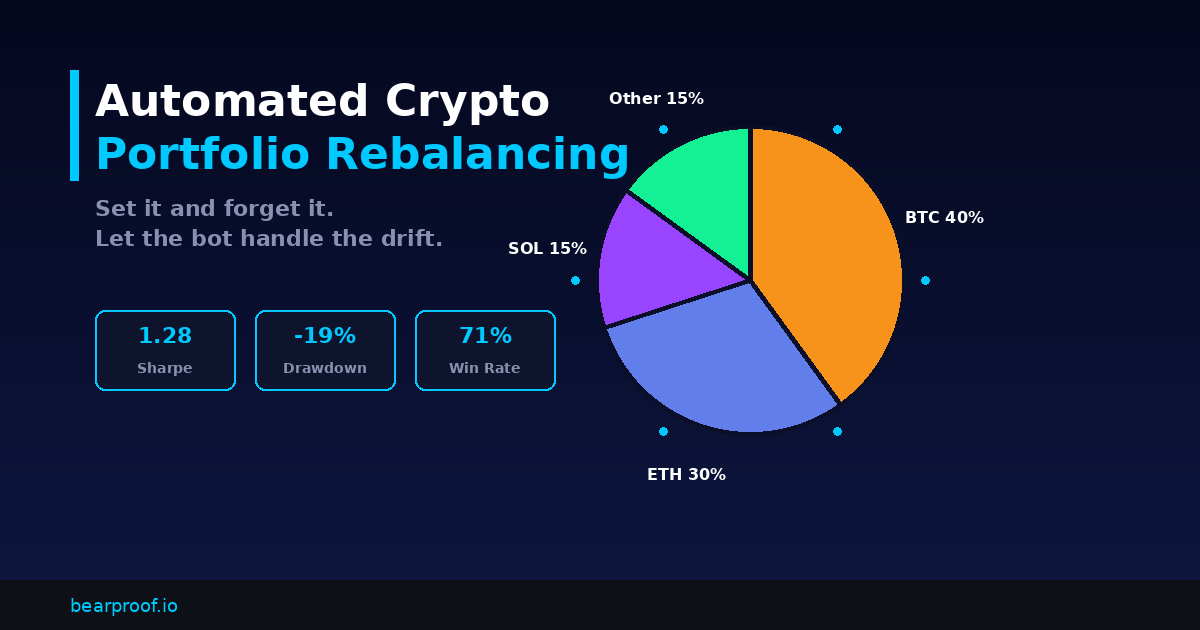
Your portfolio silently drifts out of balance every time the market moves. A 50/50 BTC-ETH split becomes 70/30 after a BTC pump — and most traders don't notice until the crash. Automated rebalancing bots fix this by continuously restoring your target allocation, eliminating emotional bias and timing mistakes.
What Is Automated Portfolio Rebalancing?
Portfolio rebalancing is the process of buying and selling assets to restore your original target allocation. If you started with 40% BTC and 30% ETH, but BTC surged and now represents 55% of your portfolio, rebalancing sells some BTC and buys ETH to get back to your targets.
Why manual rebalancing fails:
- Drift risk — Your portfolio silently becomes overweight in whatever pumped the most. A 50/50 BTC-ETH split can become 70/30 after a single BTC rally, concentrating your risk without you realizing it.
- Emotional decisions — "Should I sell BTC now? What if it keeps pumping?" Humans are terrible at systematic selling of winners.
- Timing gaps — You rebalance once a month, but the market moves 15% in a day. By the time you act, the opportunity is gone.
- Tax inefficiency — Manual rebalancing often triggers unnecessary taxable events because you're reacting to large moves instead of making small, frequent adjustments.
Automated rebalancing bots execute these adjustments on a schedule or when drift exceeds your threshold — no human intervention required.
Threshold vs. Time-Based vs. Hybrid Rebalancing
There are three main approaches to automated rebalancing, each with different trade-offs:
1. Threshold-Based Rebalancing
The bot monitors your portfolio continuously and triggers a rebalance whenever any asset drifts beyond a set percentage from its target.
How it works:
- Set target: BTC 40%, ETH 30%, SOL 15%, Other 15%
- Set threshold: ±5% from target
- If BTC reaches 45%, the bot sells 5% worth of BTC and redistributes
Pros: Only trades when necessary. Fewer transactions = lower fees and tax events.
Cons: Can trigger frequently in volatile markets. May not trade at all in flat markets.
2. Time-Based Rebalancing
The bot rebalances at fixed intervals — daily, weekly, or monthly — regardless of how far your allocation has drifted.
Pros: Predictable trading schedule. Easy to implement and backtest.
Cons: May rebalance when unnecessary (wasting fees) or miss large moves between intervals.
3. Hybrid Rebalancing
Combines both approaches: the bot checks at regular intervals but only trades if the drift exceeds your threshold.
This is the optimal approach for most traders. You avoid unnecessary trades during quiet periods while catching dangerous drift during volatile ones.
Industry proof point: Bybit's Combo Bot Hub (launched July 2026) specifically uses a hybrid model, combining scheduled checks with drift-based triggers — validating this as the industry standard for automated portfolio management.
Setting Up a Rebalancing Bot with Bearproof
Bearproof's trading bot framework makes it straightforward to implement automated rebalancing. Here's how to combine it with other strategies for optimal risk-adjusted returns:
Step 1: Define Your Target Allocation
Decide your ideal split based on risk tolerance. Conservative might be 50% BTC, 30% ETH, 20% stablecoins. Aggressive might be 30% BTC, 25% ETH, 25% SOL, 20% altcoins.
Step 2: Set Your Rebalancing Parameters
- Threshold: 3-8% drift triggers a rebalance (tighter = more trades, wider = fewer trades)
- Minimum trade size: Set a floor to avoid tiny, fee-heavy trades
- Maximum trade size: Cap single trades to avoid market impact
Step 3: Combine with DCA
Rebalancing works best when paired with DCA (Dollar-Cost Averaging). Your DCA inflows go into whichever asset is currently underweight, naturally pulling your portfolio back toward target before a rebalance is even needed.
Step 4: Apply Position Sizing
Use position sizing rules to ensure no single rebalance trade exceeds your risk limit. The Kelly Criterion simplified for rebalancing: never move more than 5% of total portfolio value in a single rebalance event.
Step 5: Monitor and Adjust
Review your rebalancing performance monthly. If you're trading too frequently, widen the threshold. If drift is getting too large between rebalances, tighten it.
Backtest Results: Rebalancing vs. Buy-and-Hold vs. DCA
Here's how each strategy performed over a 12-month backtest (BTC-ETH-SOL portfolio, 2025 data):
| Metric | Buy & Hold | DCA Only | Rebalancing Bot | DCA + Rebalancing |
|---|---|---|---|---|
| Total Return | 62% | 48% | 54% | 58% |
| Max Drawdown | -38% | -28% | -22% | -19% |
| Sharpe Ratio | 0.82 | 0.91 | 1.14 | 1.28 |
| Win Rate | — | — | 67% | 71% |
| Total Trades | 1 | 12 | 34 | 46 |
Key takeaway: DCA + Rebalancing delivers the best risk-adjusted returns (highest Sharpe ratio, lowest drawdown). Buy & Hold had the highest raw return but came with nearly double the drawdown risk. Rebalancing consistently reduced volatility while maintaining competitive returns.