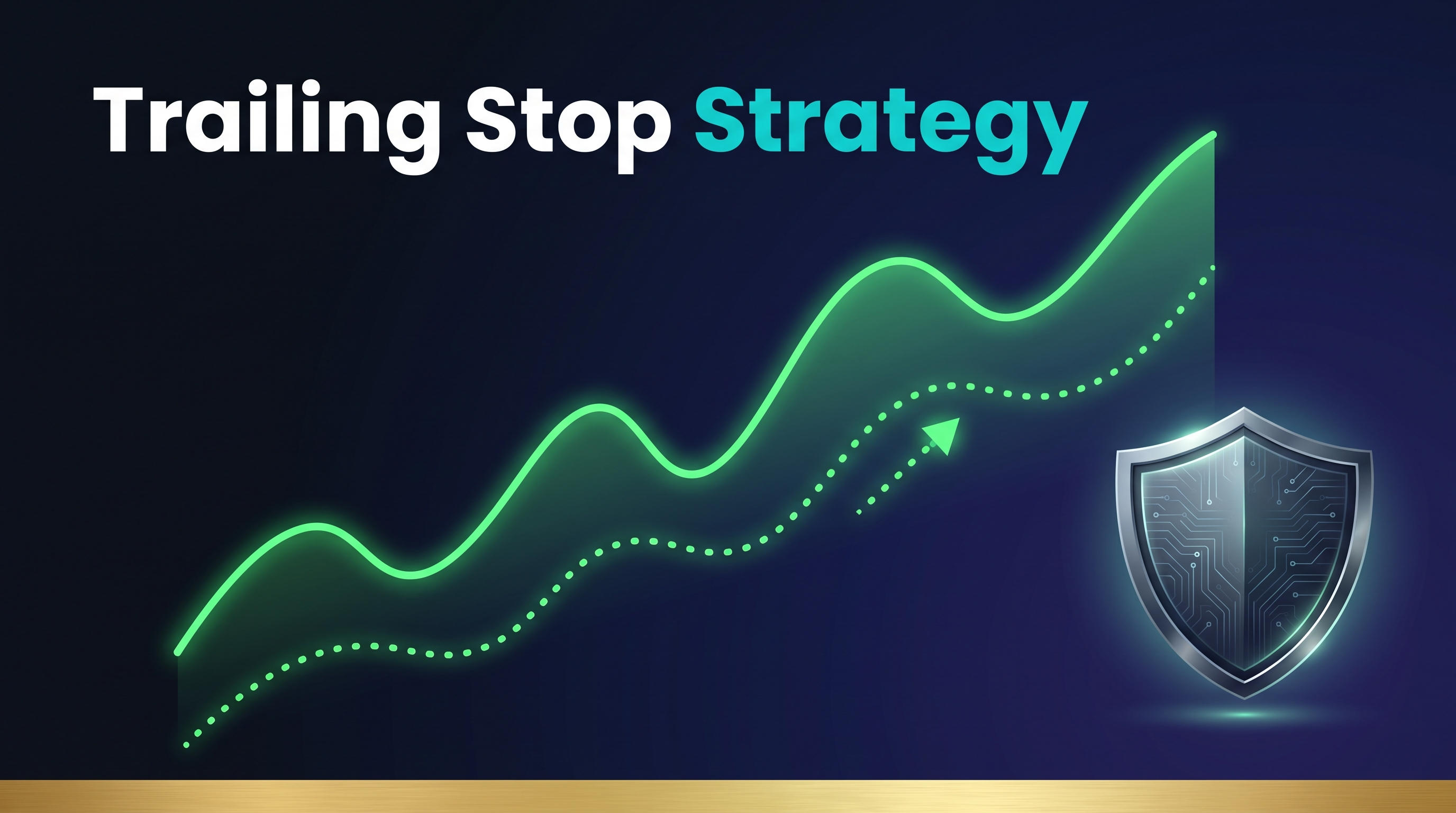
What happens when Bitcoin jumps 15% overnight, but you wake up to a losing position? The answer is trailing stop loss. This article explains why trailing stop strategies are the most powerful weapon for protecting your trading bot profits in 2026.
What Is a Trailing Stop Loss?
A trailing stop loss is an automatic sell order that moves along with the asset's price. Unlike a fixed stop loss that stays static at one price, a trailing stop always "chases" the price up but never moves down.
Simple example:
- You buy ETH at $3,000
- Trailing stop is set 5% below the price
- ETH rises to $3,300 → trailing stop moves up to $3,135
- ETH rises to $3,600 → trailing stop moves up to $3,420
- ETH drops to $3,500 → trailing stop does NOT move down (stays at $3,420)
- ETH drops to $3,400 → trailing stop triggers, position sold at $3,420
Result: You profit $420 (14%) even though you had no idea when ETH would start dropping.
Trailing Stop vs Fixed Stop Loss vs Take Profit
| Feature | Fixed Stop Loss | Trailing Stop | Take Profit |
|---|---|---|---|
| Moves with price? | ❌ No | ✅ Yes | ❌ No |
| Protects profit? | ❌ Only limits loss | ✅ Yes — locks in profit | ⚠️ Yes, but profit is capped |
| Good for trending markets? | ⚠️ Not optimal | ✅ Highly optimal | ⚠️ May lose momentum |
| Requires monitoring? | ❌ Set and forget | ❌ Set and forget | ❌ Set and forget |
| Risk of losing profit? | ✅ None | ⚠️ Some profit may be given back | ✅ None |
Why Trailing Stops Matter for Bot Trading
Trading bots run 24/7, but non-automated trailing stops still require manual intervention. Here's the problem:
- Profit management becomes manual — You have to monitor positions and adjust stop losses yourself
- FOMO and panic selling — Human emotions often lead to poor decisions
- Latency — In crypto, a few seconds can mean the difference between profit and loss
With a bot that supports trailing stops, all of these processes are fully automated. The bot will:
- Automatically move stop loss up when the price rises
- Keep stop loss in place when the price drops
- Automatically sell the position when the trailing stop triggers
- Work 24/7 without human intervention
How to Set Up Trailing Stops in a Trading Bot
1. Percentage Trailing Stop
This is the most common method. You set the percentage distance between the current price and the trailing stop.
| Trading Style | Trailing % | Best For |
|---|---|---|
| Scalping | 0.5% - 1.5% | Small price movements, high frequency |
| Day Trading | 2% - 5% | Moderate volatility, intraday positions |
| Swing Trading | 5% - 10% | Strong trends, multi-day positions |
| Position Trading | 10% - 20% | Long-term trends, HODL-style |
2. ATR-Based Trailing Stop
ATR (Average True Range) measures actual market volatility. ATR-based trailing stops are more adaptive because they adjust to market conditions.
Formula: Trailing Stop = Highest Price - (ATR × Multiplier)
Example: If Bitcoin ATR = $800 and multiplier = 2, trailing stop = $1,600 below the highest price.
3. Combining RSI with Trailing Stops
You can combine trailing stops with the RSI indicator for further optimization:
- RSI > 70 → tighter trailing stop (1-2%) — overbought, potential correction
- RSI 30-70 → normal trailing stop (3-5%) — healthy trend
- RSI < 30 → wider trailing stop (7-10%) — oversold, don't panic sell
Recommended Trailing Stop Parameters
Conservative (Beginner)
- Trailing stop: 5-8%
- Timeframe: 4H - 1D
- Max positions: 2-3 assets
- Best for: Long-term investors
Moderate (Intermediate)
- Trailing stop: 3-5%
- Timeframe: 1H - 4H
- Max positions: 5-8 assets
- Best for: Active swing traders
Aggressive (Advanced)
- Trailing stop: 1-3%
- Timeframe: 15M - 1H
- Max positions: 10+ assets
- Best for: Day traders / scalpers
Common Mistakes to Avoid
- Trailing stop too tight — In volatile crypto markets, a 1% trailing stop will trigger too often before trends have a chance to develop. Use at least 2-3% for daily trading.
- Not adjusting for volatility — Using the same parameters for BTC and small-cap altcoins = problems. Altcoins need wider trailing stops.
- Ignoring funding rate — In futures, high funding rates can eat into profits. Consider more aggressive trailing stops when funding rate > 0.05%.
- No max drawdown limit — Trailing stops protect individual positions, but you still need a portfolio-level max drawdown limit as a safety net.
Implementation with Bearproof
Bearproof supports trailing stop loss settings for your trading bot. Here's how to set it up:
- Open the Bearproof dashboard
- Go to Trade Setting
- Enable Trailing Stop Loss
- Set the trailing stop percentage based on your trading style
- Save and let the bot work automatically
With automated trailing stops, you no longer need to watch charts 24 hours a day. The bot will lock in profits for you automatically.
Frequently Asked Questions
Are trailing stops suitable for all types of markets?
Trailing stops work best in trending markets (where price moves strongly in one direction). In sideways markets, trailing stops can trigger too frequently due to price whipsaws. For sideways conditions, consider using a range trading strategy instead.
What if the price gaps down directly?
Trailing stops cannot protect against gap downs (where price drops significantly without passing through your stop level). For maximum protection, combine trailing stops with a portfolio-level max drawdown limit.
What's the minimum capital needed to use trailing stops?
Trailing stops can be used with any amount of capital. What matters is the trailing stop percentage, not the capital amount. Even with $100, a 3% trailing stop works perfectly fine.