What Is a Grid Trading Bot?
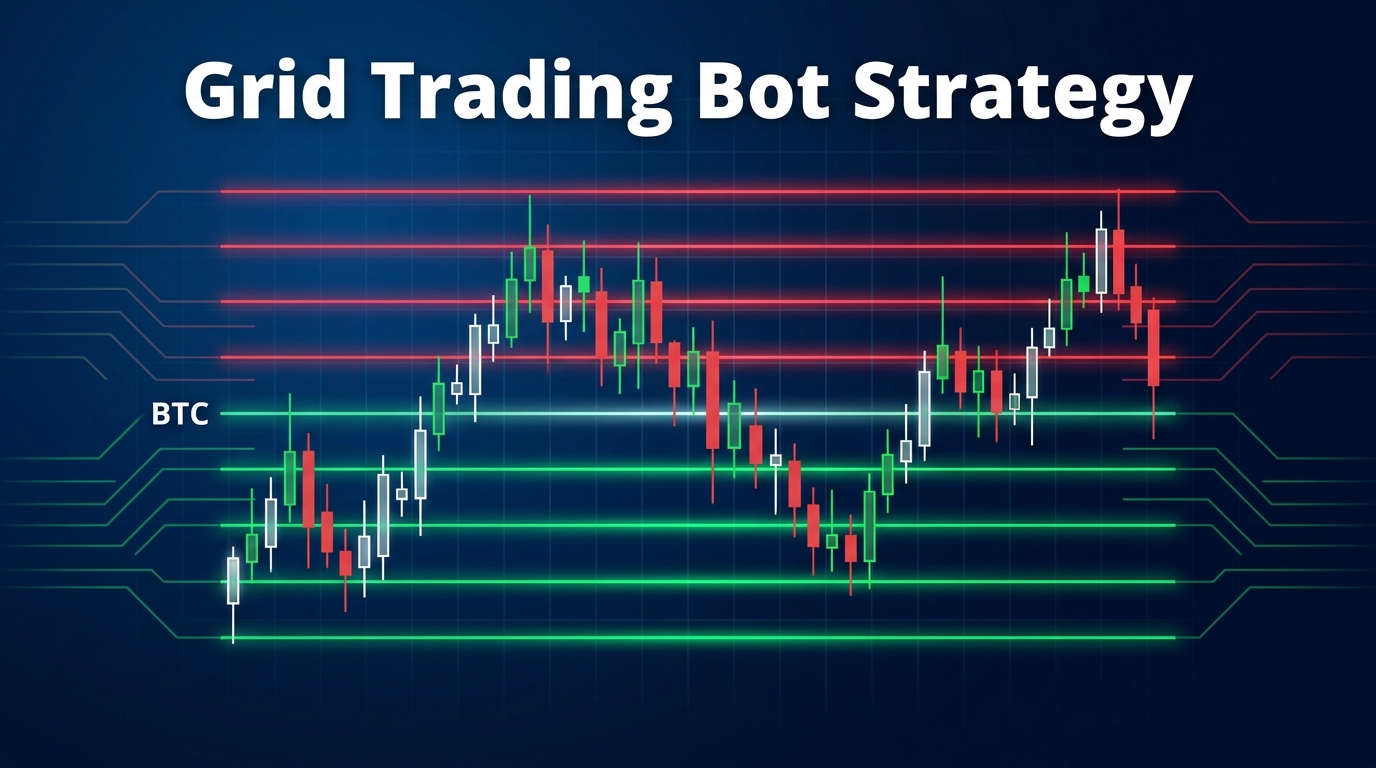
A grid trading bot is an automated trading tool that places buy and sell orders at preset price intervals within a defined range. Instead of trying to predict where the market will go, the bot profits from natural price fluctuations — buying low and selling high repeatedly within a "grid" of price levels.
Think of it like this: imagine setting up 10 buy orders below the current price and 10 sell orders above it. Every time the price drops to a buy level, the bot buys. Every time it rises to a sell level, the bot sells. Each completed buy-sell cycle captures a small profit. Multiply that by dozens or hundreds of cycles per day, and the gains add up.
How Grid Trading Bots Work
Grid trading operates on a simple principle: volatility is opportunity. The bot creates a "grid" of evenly spaced price levels between an upper and lower bound. Here's the mechanics:
1. Set Your Range: Define the upper price limit (where you'll sell) and lower price limit (where you'll buy). This range should encompass expected price movement.
2. Place Grid Levels: The bot divides your range into equal intervals. For example, with BTC at $60,000, a range of $55,000–$65,000, and 10 grid levels, the bot places orders every $1,000.
3. Execute Automatically: As the price moves up and down through your grid levels, the bot automatically executes buy and sell orders — no manual intervention needed.
4. Repeat: The cycle continues as long as the price stays within your defined range.
Grid Trading vs Other Bot Strategies
Grid trading isn't the only automated strategy available. Here's how it compares:
Grid vs DCA (Dollar-Cost Averaging): DCA bots buy at regular time intervals regardless of price. Grid bots buy and sell based on price levels. Grid bots profit from sideways markets; DCA bots work best in trending markets.
Grid vs Trailing Stop: Trailing stop bots follow the trend and sell when momentum reverses. Grid bots don't follow trends — they exploit range-bound movement. A trailing stop bot would miss profits in a sideways market that a grid bot captures.
Grid vs Stop Loss/Take Profit: Stop loss and take profit are risk management tools, not profit-generation strategies. Grid bots actively generate profits from price movement. They work best when combined with proper risk management.
When Grid Trading Works Best
✅ Ideal Conditions:
• Sideways/ranging markets: BTC oscillating between $58K–$62K is grid paradise
• High volatility within a range: More price movement = more grid executions = more profit
• Established support/resistance levels: Clear boundaries make grid ranges more reliable
❌ Poor Conditions:
• Strong trending markets: If BTC breaks above your grid ceiling, you sell too early and miss the rally
• Low volatility: If the price barely moves, few grid levels trigger
• Unpredictable breakouts: Sudden crashes below your grid floor mean unrealized losses
How to Set Up a Grid Trading Bot
Step 1: Choose Your Asset
Pick a volatile but range-bound pair. BTC/USDT, ETH/USDT, and SOL/USDT are popular choices. Avoid low-volume pairs — liquidity matters for execution speed.
Step 2: Define Your Grid Range
Use support and resistance levels to set boundaries:
• Lower bound: Recent support level (where price has bounced)
• Upper bound: Recent resistance level (where price has rejected)
Step 3: Set Grid Density
More grid levels = smaller profits per trade but more frequent executions. Fewer levels = larger profits per trade but fewer opportunities.
• Conservative (5–10 levels): Lower risk, lower frequency
• Standard (15–25 levels): Balanced approach
• Aggressive (30–50 levels): High frequency, smaller margins
Step 4: Configure Investment Amount
Allocate only what you can afford to have locked in the grid. A common approach: 50% of grid capital for buy orders, keep 50% as reserve for lower buys.
Step 5: Monitor and Adjust
Grid bots aren't "set and forget forever." Re-evaluate your range weekly. If the price breaks out of your grid, pause and reset with new levels.
Grid Trading Bot Profit Calculation
Here's a simple formula to estimate grid profit:
Profit per grid = (Upper Price - Lower Price) / Number of Grids × Investment per Grid
Example:
• ETH price: $3,200
• Grid range: $3,000–$3,400
• 20 grid levels
• Investment: $2,000
• Profit per grid: ($3,400 - $3,000) / 20 = $20 per level
• If the price oscillates through all 20 levels in a day: $20 × 20 = $400 gross profit
• Minus trading fees (typically 0.1% per trade × 40 trades = ~$8): ~$392 net
Remember: this is an ideal scenario. Real markets don't always hit every grid level.
Fee Optimization for Grid Trading
Fees eat into grid profits fast because you're executing many trades. Optimization strategies:
• Use limit orders: Maker fees (0.02%) are cheaper than taker fees (0.04%) on most exchanges
• Trade on fee-friendly pairs: Some exchanges offer zero-fee trading on select pairs
• Use exchange tokens: BNB on Binance, FTT on FTX — pay fees with native tokens for 25% discount
• Wider grids = fewer trades: Reduce grid density to cut total fees
Risk Management for Grid Trading
1. Position Sizing: Never risk more than 5% of your portfolio on a single grid setup. Diversify across 2–3 pairs.
2. Stop Loss: Set a hard stop below your grid floor. If price crashes through support, you don't want unlimited downside.
3. Range Review: Re-evaluate your grid range weekly. Markets shift — your range should too.
4. Avoid Over-Leveraging: Grid bots with leverage amplify both gains AND losses. Start with spot trading before considering futures grids.
Common Grid Trading Mistakes
❌ Setting range too narrow: If the price moves beyond your grid quickly, you miss profits and face losses.
❌ Ignoring fees: A grid that profits $0.50 per trade but costs $0.40 in fees is barely worth running.
❌ No stop loss: A flash crash below your grid floor without a stop loss can wipe out days of grid profits.
❌ Trading low-volume pairs: Illiquid pairs lead to slippage and poor execution prices.
❌ Forgetting about taxes: Every grid trade is a taxable event in most jurisdictions. Track your trades.
Related Articles
• Crypto Trading Bot Guide — Complete Beginner's Handbook
• DCA Crypto Bot Strategy — Automated Dollar-Cost Averaging
• What Is a Crypto Trading Bot? Full Explanation
Why Trade Manually When Bearproof Does It For You?
Our AI-powered trading bot handles everything:
• ✅ Entry signals — automatically detected
• ✅ Position sizing — risk-managed
• ✅ Take profit — locked in at optimal levels
• ✅ Stop loss — protected 24/7
• ✅ DCA strategy — smart averaging
No need to watch charts all day. Bearproof trades for you.
🚀 Start trading now → bearproof.io