Your crypto portfolio was perfectly balanced when you set it up. Six months later, Bitcoin's 40% rally has turned your carefully planned 60/40 split into an 80/20 mess. You're now over-exposed to BTC risk and under-exposed to the altcoins that could deliver the next 10x. This is portfolio drift — and it's quietly destroying your returns.
The good news? Automated portfolio rebalancing solves this problem permanently. Set your target allocation once, and a trading bot handles the rest — buying low, selling high, and keeping your portfolio exactly where you want it. No manual tracking, no emotional decisions, no missed rebalancing windows.
In this guide, you'll learn what portfolio rebalancing actually is, why manual rebalancing fails most traders, and how to set up automated rebalancing that works while you sleep.
Start Rebalancing with Bearproof →What Is Portfolio Rebalancing?
Portfolio rebalancing is the process of realigning your crypto holdings back to your original target allocation. When one asset outperforms others, it becomes a larger percentage of your portfolio — increasing your concentration risk. Rebalancing restores the balance by trimming winners and adding to underperformers.
Here's a simple example:
You start with:
- BTC: 60% ($6,000 of $10,000)
- ETH: 25% ($2,500)
- SOL: 15% ($1,500)
After a BTC rally, your portfolio becomes:
- BTC: 75% ($11,250 of $15,000)
- ETH: 17% ($2,500)
- SOL: 8% ($1,250)
You're now 75% exposed to Bitcoin — way more risk than you intended. Rebalancing sells some BTC and buys ETH/SOL to restore your 60/25/15 target.
The Problem with Manual Rebalancing
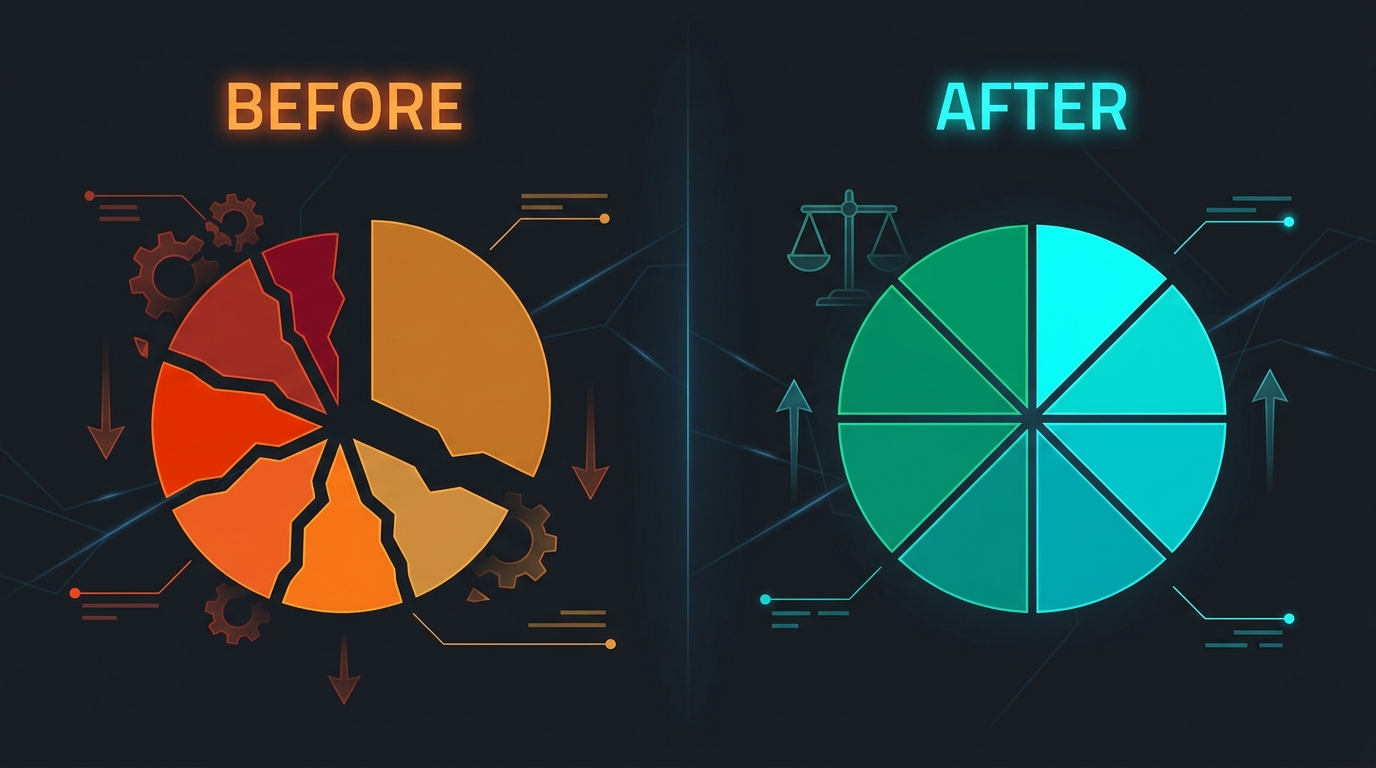
Most traders know they should rebalance, but almost nobody does it consistently. Here's why:
1. It's Time-Consuming
Checking prices, calculating new percentages, placing multiple trades across different pairs — manual rebalancing can take 30-60 minutes per session. Multiply that by weekly or monthly rebalancing, and you're spending hours on something a bot does in seconds.
2. Emotional Decisions Kill Returns
Selling your best performer feels wrong. When Bitcoin is pumping, the last thing you want to do is sell. But that's exactly what rebalancing requires — trimming winners to buy laggards. Humans are terrible at this. Bots don't have feelings.
3. You Miss the Optimal Window
Market conditions change fast. The best time to rebalance is when there's a significant deviation from your target — but by the time you notice, the window may have closed. Automated systems detect deviations in real-time and execute immediately.
4. Tax Complexity
Tracking cost basis for multiple rebalancing trades across tax years is a nightmare. Automated systems log every transaction, making tax reporting significantly easier.
How Automated Rebalancing Works
Automated rebalancing follows a systematic process that removes human bias entirely:
Step 1: Define Your Target Allocation
Set your desired percentages for each asset. For example: 50% BTC, 30% ETH, 20% SOL. This becomes your baseline.
Step 2: Choose Your Trigger Method
| Method | How It Works | Best For |
|---|---|---|
| Time-Based | Rebalance at fixed intervals (daily, weekly, monthly) | Passive investors who want simplicity |
| Threshold-Based | Rebalance when any asset deviates by X% from target | Active traders who want precision |
| Hybrid | Check daily, rebalance only if deviation exceeds threshold | Best of both worlds — most popular |
Step 3: Set Risk Parameters
Configure maximum trade sizes, daily rebalancing limits, and minimum deviation thresholds to avoid over-trading and excessive fees.
Step 4: Let the Bot Execute
The bot monitors your portfolio continuously. When rebalancing conditions are met, it places the necessary trades automatically — selling overperformers and buying underperformers to restore your target allocation.
Asset Allocation Models
Different allocation strategies suit different goals:
| Model | Description | Risk Level |
|---|---|---|
| Equal-Weight | Same percentage in each asset (33/33/33) | Medium — maximum diversification |
| Market-Cap Weighted | Allocation based on market cap (BTC-heavy) | Lower — follows the market |
| Risk-Parity | Equal risk contribution from each asset | Lower — volatility-adjusted |
| Momentum-Based | Higher allocation to recent winners | Higher — trend-following |
Real Numbers: How Rebalancing Protects Your Portfolio
Let's compare two portfolios over 12 months with 40% BTC volatility and 60% ETH volatility:
Portfolio A (No Rebalancing):
- Start: $10,000 (50% BTC, 50% ETH)
- BTC rallies 80%, ETH drops 20%
- End: BTC $7,200 + ETH $4,000 = $11,200
- Actual allocation: 64% BTC, 36% ETH (heavily skewed)
Portfolio B (Monthly Rebalancing):
- Start: $10,000 (50% BTC, 50% ETH)
- Monthly rebalancing sells BTC rallies, buys ETH dips
- End: $11,800 (maintains 50/50 allocation)
- Captured BTC upside while accumulating ETH at lower prices
The difference? $600 — and Portfolio B carries less concentration risk.
How Bearproof Makes It Easy
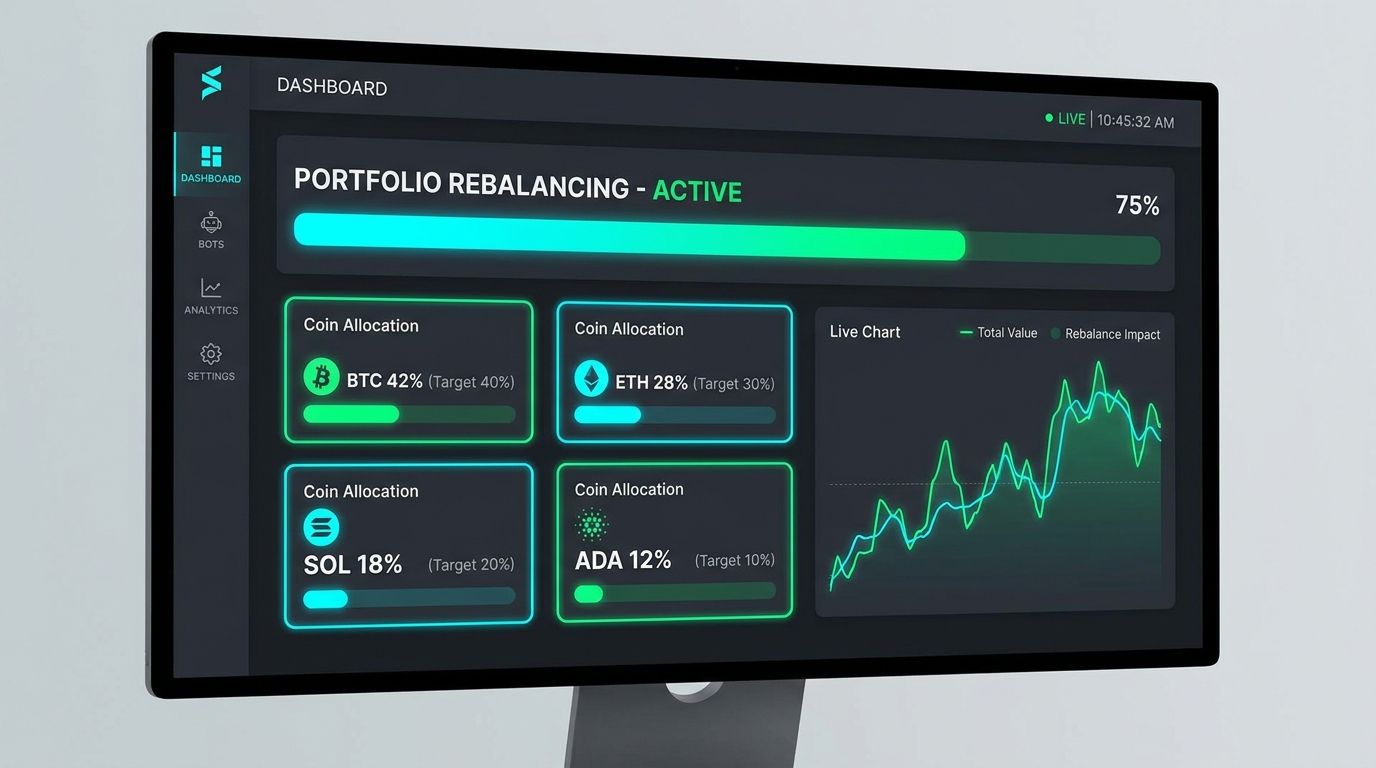
Bearproof's automated rebalancing takes the complexity out of portfolio management:
- No-Code Strategy Builder — set your target allocation with a simple visual interface
- Multi-Coin Support — rebalance across BTC, ETH, SOL, ADA, and dozens more
- Flexible Triggers — time-based, threshold-based, or hybrid
- Exchange Integration — connects directly to Binance, Bybit, and other major exchanges via secure API
- Real-Time Monitoring — see your portfolio drift and rebalancing activity in real-time
- Risk Controls — set max trade sizes and daily limits to protect against over-trading
Risks and Disclaimer
Automated rebalancing reduces many risks but doesn't eliminate all risk. Be aware of:
- Market Risk: Rebalancing doesn't protect against overall market crashes — it only manages allocation
- Fee Impact: Frequent rebalancing can generate significant trading fees — use appropriate thresholds
- Tax Implications: Each rebalancing trade may be a taxable event — consult a tax professional
- Slippage: Large rebalancing trades in illiquid markets may execute at unfavorable prices
This article is for educational purposes only and does not constitute financial advice. Always do your own research.
Frequently Asked Questions
How often should I rebalance my crypto portfolio?
Most experts recommend monthly or quarterly rebalancing for long-term investors. More frequent rebalancing (weekly or threshold-based) suits active traders but increases fee exposure. The hybrid approach — checking daily but only rebalancing when deviation exceeds 5% — offers the best balance for most people.
Does rebalancing reduce profits?
Rebalancing actually improves risk-adjusted returns by forcing you to sell high and buy low. While it may underperform a pure momentum strategy during strong trends, it protects against concentration risk and reduces portfolio volatility. Studies show rebalanced portfolios have better Sharpe ratios over 3-5 year periods.
What's the minimum amount to start rebalancing?
You can start with as little as $100 on Bearproof. However, rebalancing makes more sense with larger portfolios ($1,000+) where the allocation shifts are meaningful enough to justify trading fees.
Is automated rebalancing safe?
Bearproof uses API keys with trade-only permissions — withdrawal access is never required. Your funds stay on your exchange. The bot only executes trades you've authorized within the parameters you set. You can pause or stop rebalancing at any time.
Can I rebalance across different exchanges?
Currently, Bearproof rebalances within a single connected exchange. For multi-exchange rebalancing, connect each exchange separately and manage allocations independently on each platform.
Start Automating Your Portfolio
Portfolio drift is the silent killer of crypto returns. Every day your allocation sits unbalanced, you're taking on more risk than you planned for — or missing opportunities to buy dips. Automated rebalancing removes the guesswork, the emotion, and the time commitment from portfolio management.
Set your allocation, configure your triggers, and let Bearproof handle the rest.
Start Rebalancing with Bearproof →Last updated: June 2026