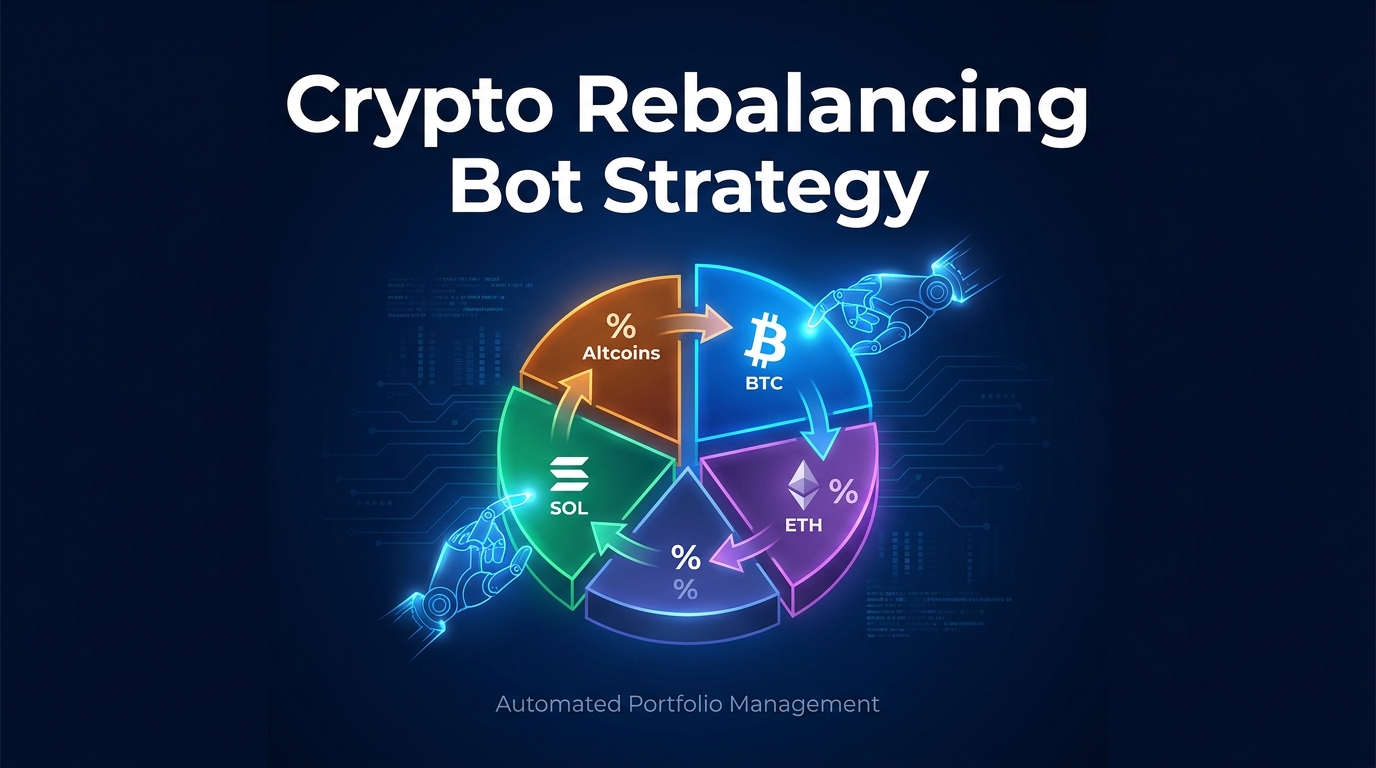
What Is a Crypto Rebalancing Bot Strategy?
A crypto rebalancing bot strategy is an automated approach that maintains your desired portfolio allocation by periodically buying and selling assets. Instead of letting one coin dominate your portfolio after a pump, the bot automatically trims winners and adds to underperformers — enforcing discipline that most traders struggle with manually.
Think of it as autopilot for your portfolio allocation. You set the target (e.g., 40% BTC, 30% ETH, 30% SOL), and the bot does the rebalancing work — whether that's every hour, every day, or when allocations drift beyond a threshold.
Why Rebalancing Matters in Crypto
Crypto markets are volatile. A coin that's 20% of your portfolio today could be 40% after a rally — or 10% after a crash. Without rebalancing:
• Concentration risk: One coin's pump creates outsized exposure
• Missed profits: You don't automatically take profits from winners
• Drift: Your carefully planned allocation slowly becomes something else entirely
Rebalancing enforces the timeless advice: buy low, sell high — systematically, without emotion.
3 Core Rebalancing Strategies
1. Time-Based Rebalancing
The simplest approach: rebalance at fixed intervals — daily, weekly, or monthly.
• ✅ Easy to understand and implement
• ✅ Predictable execution (good for planning)
• ❌ May rebalance too often (unnecessary trades) or too rarely (missed drift)
• Best for: Beginners, long-term holders, passive investors
2. Threshold-Based Rebalancing
Rebalance only when an asset drifts beyond a set percentage from its target allocation.
• Example: BTC target is 40%, threshold is 5%. Rebalance when BTC hits 45% or drops to 35%.
• ✅ Only trades when necessary — fewer fees
• ✅ Adapts to market conditions automatically
• ❌ More complex to set up
• Best for: Active portfolios, volatile markets, fee-conscious traders
3. Hybrid (Time + Threshold)
Check allocation on a schedule, but only rebalance if the drift exceeds the threshold.
• Example: Check daily, rebalance only if any asset drifts >5%.
• ✅ Best of both worlds — systematic but efficient
• ✅ Reduces unnecessary trades while staying disciplined
• ❌ Requires more configuration
• Best for: Most crypto investors — this is the recommended approach
How to Build a Rebalancing Bot Strategy
Step 1: Define Your Target Allocation
Your allocation should reflect your risk tolerance and market outlook:
• Conservative: 50% BTC, 30% ETH, 20% stablecoins
• Balanced: 40% BTC, 30% ETH, 20% SOL, 10% altcoins
• Aggressive: 30% BTC, 30% ETH, 20% SOL, 20% high-conviction alts
Step 2: Set Rebalancing Triggers
Choose your strategy (time, threshold, or hybrid) and configure:
• Time interval: How often to check (daily recommended for most)
• Threshold: How far allocation must drift before rebalancing (3–10% typical)
• Minimum trade size: Avoid tiny trades that get eaten by fees
Step 3: Configure Risk Parameters
• Max single rebalance size: Limit how much you move per rebalance (e.g., max 20% of portfolio)
• Emergency stop: Halt rebalancing if total portfolio drops >X% in 24h
• Whitelist: Only rebalance approved assets — avoid scam coins entering your portfolio
Step 4: Fee Optimization
Rebalancing generates trades, and trades generate fees. Optimize by:
• Using limit orders (maker fees vs taker fees)
• Setting minimum trade thresholds (don't rebalance $5 trades)
• Using exchange-native tokens for fee discounts (BNB, CRO)
• Choosing low-fee exchanges for rebalancing execution
Rebalancing Bot vs Manual Rebalancing
Manual Rebalancing:
• Requires constant monitoring
• Emotional decisions (reluctant to sell winners)
• Easy to procrastinate or forget
• Tax events must be tracked manually
Bot Rebalancing:
• Executes automatically 24/7
• Zero emotion — pure discipline
• Never misses a rebalance
• Trade history for tax reporting
The difference compounds over time. A bot that rebalances weekly for a year executes 52 disciplined rebalances. Most humans? Maybe 4–6 before getting distracted.
Portfolio Rebalancing Frequency: How Often?
There's no universal answer — it depends on your strategy and market conditions:
• Daily: Works for high-volatility portfolios. More trades = more fees, but tighter allocation control.
• Weekly: Good balance for most investors. Captures meaningful drift without excessive trading.
• Monthly: Suitable for long-term holders with low-volatility portfolios. Fewer fees, wider allocation swings.
• Threshold-only: Market-driven. Rebalances when needed, not on a calendar. Often the most efficient.
Rule of thumb: Start with weekly hybrid (check daily, rebalance if >5% drift). Adjust based on your fee tolerance and allocation precision needs.
Common Rebalancing Mistakes
❌ Rebalancing too frequently: Daily rebalancing on a low-volatility portfolio wastes fees. Match frequency to volatility.
❌ Ignoring tax implications: Every rebalance is a taxable event in most jurisdictions. Track your cost basis.
❌ No minimum trade size: Rebalancing $2 costs more in fees than it's worth. Set minimum thresholds.
❌ Over-complicating allocation: 15-coin portfolios are hard to manage. Start with 3–5 core assets.
❌ Chasing performance: Don't change your allocation because one coin pumped. Stick to your strategy.
❌ No emergency stop: If markets crash 30% in a day, you might want to pause rebalancing and assess.
Related Articles
• Automated Crypto Rebalancing Bot — How It Works
• Crypto Bot Money Management Strategy
• Portfolio Rebalancing Guide for Crypto
Why Trade Manually When Bearproof Does It For You?
Our AI-powered trading bot handles everything:
• ✅ Entry signals — automatically detected
• ✅ Position sizing — risk-managed
• ✅ Take profit — locked in at optimal levels
• ✅ Stop loss — protected 24/7
• ✅ DCA strategy — smart averaging
No need to watch charts all day. Bearproof trades for you.
🚀 Start trading now → bearproof.io